
Home > Why Taipei > Overview of Taipei
Overview of Taipei
Taipei, Taiwan’s political, economic, and cultural hub, is home to around 2.46 million people. Bordering New Taipei City and Keelung City, it forms the core of Northern Taiwan’s most vital metropolitan area. Thanks to its prime location, high quality of life, excellent public safety, and comprehensive infrastructure, spanning transportation, ICT, healthcare, and education, Taipei attracts multinational corporations, international financial institutions, and houses many foreign consulates and trade offices.
Situated at the heart of Asia-Pacific trade, the Taipei City Government has launched a “Smart City New Economy” initiative to facilitate a sustainable business environment. This strategy emphasizes digitalization, smartization, and greenization innovation, supported by three industry parks: the Nangang Software Park for IC design and digital content, the R&D-rich Neihu Technology Park, and the emerging Beitou-Shilin Technology Park. By integrating cutting-edge applications into urban management, marketing, tourism, transportation, healthcare, and education, Taipei has become a vibrant center of commerce and culture and consistently ranks highly in international city indexes.
With abundant capital, talent, and technology, Taipei’s industrial structure is formed by professional services and knowledge-based innovation. Priority sectors for investment include ICT, biotech, services, finance, cultural and creative industries, tourism, healthcare, international cuisine, green sustainability, and MICE (meetings, incentives, conferences, and exhibitions).
Over 3,650 foreign-invested enterprises are registered here, accounting for more than 70% of Taiwan’s total foreign investment. Leading R&D centers and headquarters cluster in Neihu and Nangang, making them national industry hubs. The city hosts multiple crucial academic institutions within Taiwan, including 23 universities and Academia Sinica, and over 80% of its workforce holds a tertiary degree, fueling ongoing innovation and entrepreneurial momentum.
Boasting a pleasant subtropical climate with an average annual temperature of 24 °C, Taipei offers both mountain and coastal scenery within an hour drive. Its rich history has fostered a multicultural, open-minded atmosphere. This combination of business opportunities, livability, educational resources, and career prospects has won acclaim from both locals and internationals alike.
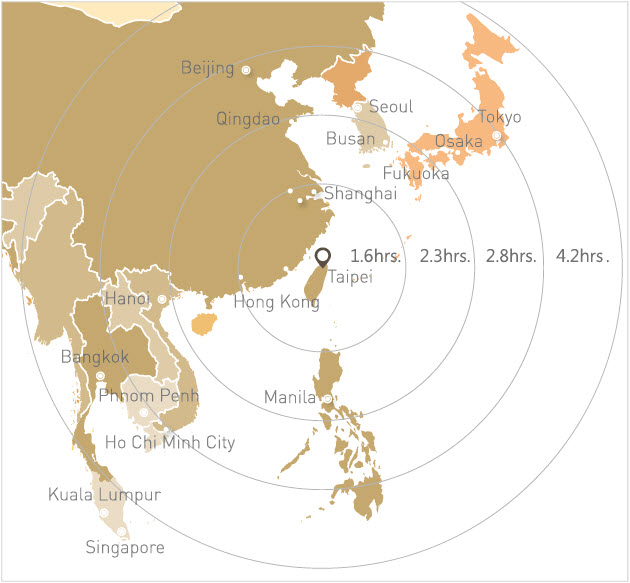
Taipei is near cities including Hangzhou, Shanghai, Xiamen, Shenzhen, Hong Kong, Manila, Guangzhou, Macau, Fukuoka, Osaka, Tokyo, Bangkok, Phnom Penh, Ho Chi Minh City, Singapore, Kuala Lumpur, Hanoi, and Beijing.
Taipei characteristics
- Comprehensive Transport Network
- Knowledge and Talent
- Law and Democracy
- No Language Barrier
- Diverse Professional Talent
Taipei's Investment Environment
| Nature | Geographical Location | North Taiwan, 25°02′N 121°38′E |
|---|---|---|
| Surface Area | 271.8 square km | |
| Climate | Tropical, monsoon climate, average annual temperature 24 degrees Celsius | |
| People | Population | 2.46 million |
| Population Density | 9,038 persons per square kilometer | |
| Population Structure | 0-14 years of age 12.13%, 15-64 years of age 64.31%, 65 years of age and above 23.56%. | |
| Average Greenness | 55.85 square meters/person | |
| Education Level | 90% has completed compulsory education, 82.16% of the workforce has completed tertiary education | |
| Economy | Workforce | 1.22 million persons |
| Employment by Sector | Agriculture/forestry/fisheries/livestock 0.26%, heavy industry 17.80%, service industry 81.86% | |
| Unemployment Rate | 3.5% | |
| Average Disposable Household Income | NT$1,059,757 | |
| CPI (May 2025) | 110.02 | |
| Annual GDP(2024) | NT$25,474,479 million | |
| Top 5 Industries | Real Estate Activities, Manufacturing, Financial and Insurance Activities, Public Administration and Defense, Human Health and Social Work Activities |